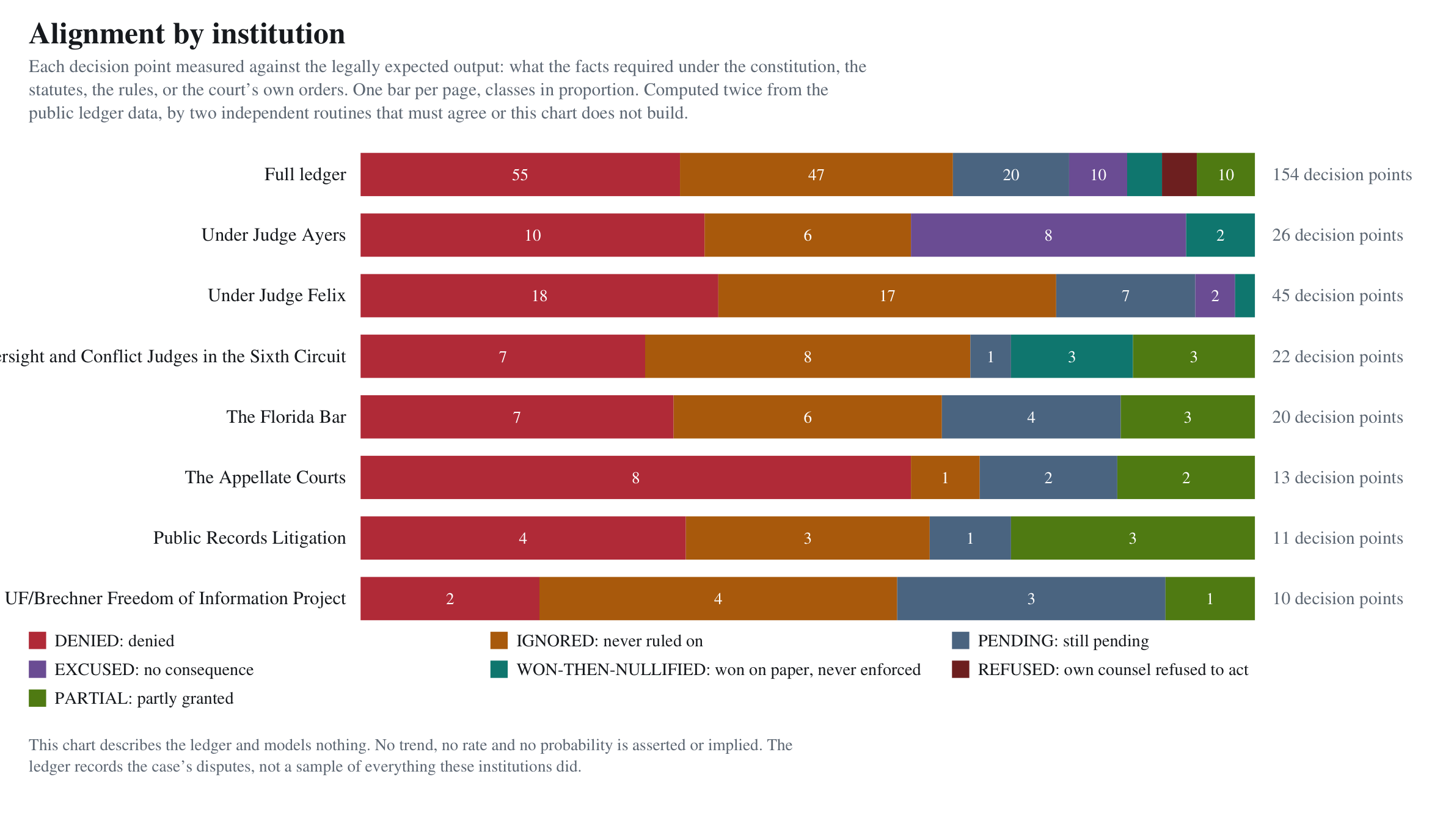
The institutions
Under Judge Ayers25 decision points
Judge Kelly Ayers offered the courthouse camera footage as proof about her own conduct. Asked to go get it, she said "No, sir" and ended the hearing.
Under Judge Felix46 decision points
Judge Matthew Felix granted Husband’s 2024 motion for Wife’s financial records from the bench and has never put it in writing. When Wife emailed chambers asking for the next guardian ad litem order, he signed it about 25 hours later. It bills Husband $3,000, due in three days.
Court Oversight and Conflict Judges in the Sixth Circuit25 decision points
Rule 2.420(l) requires "[e]xpedited review" when a Florida court withholds its administrative records. Husband’s case for the courthouse video, filed October 14, 2025, has had no final hearing. Asked in July to name the factual disputes it had found, the court said: "So, don't ask me to explain those matters to you."
The Florida Bar25 decision points
Between July 4 and July 11, 2026, Husband, a dues-paying member, asked The Florida Bar four times who pays the law firm it hired against him. The answer was a price: $101.09.
The Appellate Courts14 decision points
Husband asked the Second District Court of Appeal whether a judge he is suing may keep deciding his divorce. The court denied the petition in one sentence, seven days after it was filed.
Public Records Litigation16 decision points
The court system confirmed in writing that the April 4, 2025 hearing video exists and withheld it as security-camera footage. Ordered in August 2026 to explain, it filed three statements, and none states a fact showing that the recording is security-camera footage.
UF/Brechner Freedom of Information Project26 decision points
At 10:40 AM on May 4, 2026, UF’s own IT office wrote that its search for the records Husband requested had stalled partway through one mailbox and that seventeen messages "should have been included previously." That afternoon UF wrote to Husband: "This completes the public records request."
14 decision points sit on more than one page, because one act crossed institutions; each such card says so on its face and is counted once in the full ledger. 33 decision points belong to no institution page, because the deciding actor was a party, a lawyer for a party, or a composite across forums; they remain on the full ledger, which holds every decision point recorded so far.
Where the lanes meet: one documented loop
Three oversight bodies each declined to act by pointing at another, in their own words, on the record. The Florida Bar closed a grievance on the stated ground that the matter belonged in court. The trial judge declined to address counsel's conduct and deferred it to the Bar. The Judicial Qualifications Commission closed a complaint as a matter for the normal court process. The Bar then closed a second complaint on the same stated ground as the first, in the identical operative words, sixteen months later, through a different bar counsel.
Four referral acts, February 2025 to October 2025. The words and the receipts are on the cards: N-031, N-045, N-062, N-032. Each card opens on the full ledger.
That is the documentary claim, and it is the only cross-institution claim these pages make. The totals above it are sums, not a claim of pattern. No statistical pattern is asserted.